Sewer Line Repair in College Point, Queens
Dealing with recurring lower-level backups, sluggish basement floor drains, or persistent sewer odors? NY Plumbing delivers precise optical camera evaluations, selective structural spot fixes, and full underground lateral replacements across College Point, Queens.
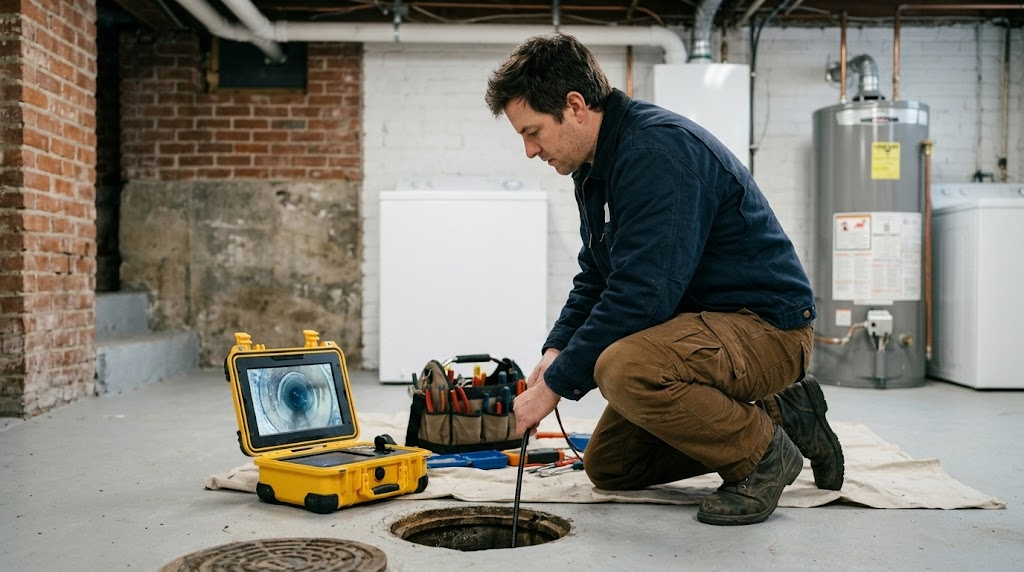
Recognizing Sewer Line Degradation & Drainage Failure
Unlike secondary fixture clogs, an obstructed or structurally compromised main sewer line affects your property's entire wastewater system, frequently threatening basement boiler rooms and foundation slabs.
Multiple Backed-Up Fixtures
When toilets, laundry basins, and basement floor drains gurgle simultaneously or back up when water is discharged on upper floors, the blockage is seated deep inside the primary sewer line rather than an isolated fixture branch.
Recurring Root Intrusion
Fine tree roots follow the moisture vapor escaping through tiny joints in aging vitreous clay and cast-iron sewer pipes. Over time, hair-like roots expand into dense root masses that snag waste solids and cause periodic line collapses.
Foul Sewer Odors Indoors
Sewer gas (hydrogen sulfide) escaping into basements, utility rooms, or perimeter foundation walls signals a broken waste pipe, cracked house trap, or dry mechanical seal allowing dangerous subterranean gases to vent indoors.
Why College Point Ground Conditions Challenge Private Sewer Laterals
Properties throughout College Point—particularly along residential avenues west of College Point Boulevard and low-lying sectors near Powell's Cove Park—often experience elevated water tables and organic coastal soil composition. Saturated subsoils exhibit hydraulic shifts throughout wet seasons, placing uneven stress on subterranean plumbing.
In classic semi-detached and single-family Queens homes constructed throughout the mid-20th century, original sewer laterals were commonly assembled from extra-heavy cast iron or sectional vitrified clay tile. After 50 to 75 years of continuous use, these materials face localized ground settlement, bellied pipe runs where solids accumulate, and severe mechanical shearing at foundation penetrations.
A compromised sewer line creates an imminent risk for basement heating rooms. Backed-up sewage can quickly submerge hydronic circulators, low-water cutoffs, and burner assemblies, turning a drainage failure into an emergency requiring boiler repair in College Point. For properties facing both groundwater and sewer vulnerability, pairing sewer line rehabilitation with a dependable sump pump & flood protection system ensures total basement resilience.
NYC DEP Property Owner Responsibility
Under New York City Department of Environmental Protection (DEP) regulations, property owners are responsible for maintaining and repairing their private building sewer lateral from the interior foundation wall all the way to the connection spur at the public street sewer main.
The Four-Step Sewer Line Investigation & Resolution Process
We avoid unnecessary property excavation by utilizing high-definition fiber-optic camera systems to confirm the exact location, depth, and nature of sewer faults before picking up a shovel.
Camera Scope & Sonde Locating
We insert a self-leveling HD optic camera into your main cleanout. An electromagnetic radio sonde transmits depth and precision coordinates to locate pipe breaks under concrete, lawns, or roadways.
Mechanical Clearing or Descaling
If the line is obstructed by roots or mineral scale, heavy-duty cable snaking or targeted hydro flushing clears standing water so that interior pipe walls and fracture points can be thoroughly analyzed.
Spot Fix vs. Trenchless Replacement
We weigh spot repair versus total lateral replacement based on pipe age, depth, and structural soundness, choosing the least invasive, longest-lasting method compliant with NYC plumbing codes.
Permitted Work & Flow Validation
All street-opening or property excavation is performed following NYC DOB and DEP permitting rules, followed by a final camera scan to verify uninterrupted gradient, airtight seals, and smooth flow.
Common Sewer Line Questions in College Point
Practical advice on sewer lateral repairs, camera scoping, and city regulatory requirements.
Because College Point borders Flushing Bay and the East River, basements and underground utilities face elevated groundwater tables. Saturated soil creates hydrostatic ground pressure that shifts older clay tile or unreinforced cast-iron pipes, cracking joints and inviting rapid root infiltration from water-seeking trees.
Spot sewer repair targets an isolated failure point, such as a single crushed hub or localized root fracture identified with a high-definition sewer camera. Complete line replacement replaces the entire private house connection from the foundation footing to the city main connection when systemic pipe degradation, widespread cracking, or significant pitch loss has occurred.
Under NYC Department of Environmental Protection (DEP) regulations, private property owners are generally responsible for maintaining and repairing the entire house lateral sewer connection that runs from the building foundation out to the connection point at the municipal sewer main, including the connection spur under the street or sidewalk.
A fiber-optic sewer camera reveals the exact condition, depth, and distance of blockages or structural fractures. This eliminates guesswork, establishes whether snaking or hydro jetting can safely clear the line, and confirms whether trench excavation is truly required, protecting driveways and landscaping from needless digging.
Suspect a Sewer Lateral Problem in College Point?
Speak directly with an experienced technician for accurate sewer camera diagnostics, spot repairs, or sewer lateral assessments.